Frijoles de la Olla: Mexican Pot Beans with Epazote
By The Sunday Pot Kitchen Updated
- • 15 minutes of active prep, then a hands-off soak of at least 5 hours, and about 2½ hours on the stove
- • 1 lb (450 g) of dried pinto beans makes 8 servings of beans in broth
- • Drain the soaked beans and cook them in fresh water
- • Boil them for 30 minutes before the gentle simmer, and never cook them from dried in a slow cooker
- • Add the salt and epazote only once the beans are tender
Ingredients
8 servingsInstructions
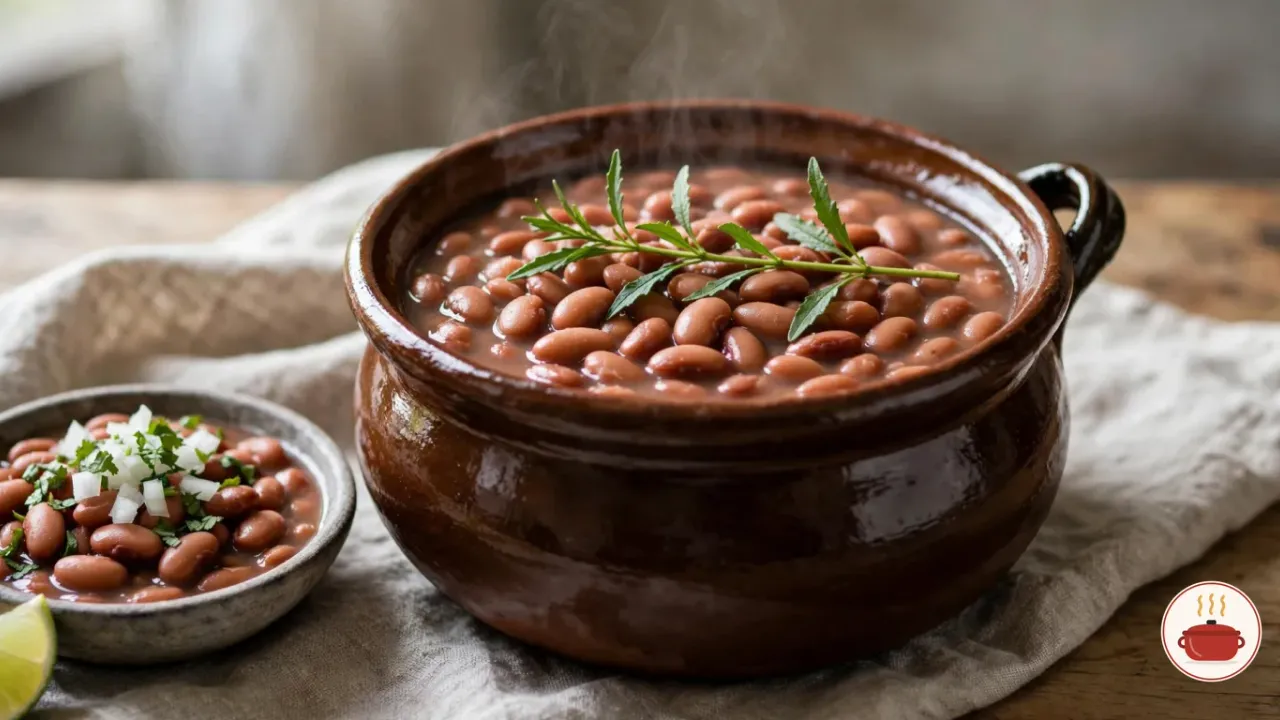
Frijoles de la olla are Mexican pot beans: dried pinto beans simmered in plenty of water with onion, garlic and epazote until soft and creamy. You soak them for at least 5 hours, mostly hands-off, boil them for 30 minutes, then simmer them for 1 to 2 hours more. They come to the table in their own savory broth.
What frijoles de la olla are
The name means “beans from the pot” in Spanish. These are the everyday beans of Mexico: plain, brothy and cooked from dried. Cooks serve them as a side dish, as a light meal with tortillas, or as the start of refried beans.
The pot in the name is the olla, a deep clay pot with a round belly and a narrow neck. The narrow top lets less broth boil away during the long cook. Many cooks also say clay gives the beans an earthy taste.
Clay heats slowly and can crack with a sudden change of heat. Bring a clay olla to the boil over medium heat, and never set a hot one down on a cold, wet surface.
A word on lead in clay pots
Some traditional glazed pottery holds lead in its glaze. If the pottery was not fired properly, that lead can leach into food. The FDA has received reports of Mexican pottery labeled “lead free” that could still leach about as much lead as lead-glazed pottery.
If you are unsure about an olla, test it with a home lead-test kit, sold in hardware stores and online. If the test shows lead, the FDA strongly advises against using the pot to cook, serve or store food. No amount of washing or boiling removes the lead.
You lose little without one. A heavy Dutch oven or any large, heavy pot makes excellent beans.
Which beans to use
Pinto beans are the classic choice in the US and across northern Mexico. They cook up creamy, and their broth turns a soft, pinkish brown. Several other Mexican favorites cook the same way:
- Pinto. A beige bean with brown speckles, which fade as it cooks. It is the easiest to find in the US.
- Black. A small, firm bean with an inky broth. It is the favorite in southern Mexico, where cooks often pair it with epazote.
- Bayo. A pale tan bean with a mild flavor and a creamy center.
- Flor de mayo. A pinkish bean mottled with purple. Its name means “May flower.”
Buy beans from a store that sells a lot of them, such as a Latin market. Fresh dried beans cook faster and more evenly. Beans that sat in the pantry for a year or two can take much longer, and some never soften at all.
Beans are a filling side. According to USDA FoodData Central, 1 cup (171 g) of cooked pinto beans holds about 245 calories, 15 grams of protein and 15 grams of fiber. The same database lists raw pinto and black beans under their species name, Phaseolus vulgaris, the common bean.
To soak or not to soak
Soaking softens dried beans before they cook. They cook faster and more evenly, and fewer skins burst. Many Mexican cooks skip the soak and simply cook the beans longer, often an hour or more.
This recipe soaks them, for safety as much as texture. The FDA’s advice for kidney beans, drawn from British studies, is to soak them for at least 5 hours and pour the water away. Then boil them in fresh water for at least 30 minutes. This recipe follows the same steps for pinto beans. The next section explains why.
Cover the beans with cold water by about 3 inches (7.5 cm), since they swell to about twice their size. Soak them overnight, or for at least 5 hours. In a warm kitchen, soak them in the refrigerator. Then drain them, and always cook them in fresh water.
If you skip the soak anyway, never skip the boil. Unsoaked beans still need their 30 minutes at a full boil, then a longer simmer.
Why dried beans must boil first
Raw and undercooked beans contain a natural toxin called phytohaemagglutinin, a kind of lectin. The FDA’s Bad Bug Book says red kidney beans hold the most. As few as 4 or 5 raw kidney beans can cause extreme nausea, severe vomiting and diarrhea. The illness usually starts within 1 to 3 hours.
Proper cooking destroys the toxin. In one study the FDA cites, 10 minutes of boiling at 212°F (100°C) destroyed it completely. Still, the FDA tells home cooks to boil the beans for at least 30 minutes. That makes sure they get hot enough, for long enough.
Slow cookers are the trap. The FDA says not to use them to cook kidney beans or dishes that contain them. In studies, casseroles cooked in slow cookers often reached only 167°F (75°C) or less inside. That is too cool to destroy the toxin.
The FDA writes its advice for red kidney beans, and it says the toxin occurs in many kinds of beans. Pinto, black, bayo and flor de mayo beans belong to the same species as red kidney beans. So this recipe treats them the same way: soak them, drain them, and boil them in fresh water for 30 minutes before the long simmer. Canned beans are already cooked, so they skip all of this.
How long to cook them
After the 30-minute boil, soaked pinto beans need 1 to 2 hours at a gentle simmer. That makes 2 to 3 hours on the stove in all, with the seasoning. Unsoaked beans often take an hour longer. Small black beans often finish a little sooner. Counting the mandatory soak, the whole recipe takes about 7 hours and 45 minutes. Most of that is hands-off soaking time, not standing at the stove.
Like a pot of Sunday gravy, a pot of beans asks for time more than effort. A few things can slow it down:
- Old beans. They take longer to soften, and the oldest may stay firm.
- Hard water. Its minerals slow the softening. Filtered water helps.
- Acid. Tomatoes, lime juice and vinegar keep the skins firm. Add them only once the beans are tender.
Do not trust the clock alone. Taste 5 beans from different parts of the pot. They are ready when all 5 are creamy all the way through, with no chalky center. Most should still hold their shape.
Keep the beans under liquid the whole time. Beans above the waterline dry out and cook unevenly. Top up with hot water from the kettle, so the pot keeps its simmer. By the end, the broth should look soupy and a little thick.
Seasoning: onion, garlic, epazote and salt
The classic seasoning is short. Half an onion and a few cloves of garlic go in at the start. They melt into the broth over the long cook and give it a sweet, savory base.
Epazote is a pungent Mexican herb with jagged leaves. Its flavor is strong and hard to pin down, somewhere between oregano, mint and citrus, with a resinous edge. Cooks in southern Mexico often add it to black beans. Many also believe it makes beans easier to digest. Two sprigs are enough for a whole pot, since too much tastes bitter. Look for fresh or dried epazote at Latin markets.
Add the salt only once the beans are tender. The broth reduces over the long cook, so salt that goes in early can end up too strong. Salting at the end lets you season the finished broth. Give the beans 20 minutes after the salt goes in, so it reaches their centers. Then taste the broth and adjust.
Some cooks stir a spoonful of lard into the pot at the end, for richness. Leave it out to keep the beans vegan.
Serving and storing
Serve the beans in small bowls with plenty of broth. Top them with chopped white onion, cilantro, a little fresh chile and a squeeze of lime. Warm corn tortillas on the side turn a bowl into a meal. Crumbled queso fresco is good too, if you do not need the beans vegan.
They sit well beside tacos, grilled meat, rice or fried eggs. They also pair well with leftover classic pot roast, shredded into warm tortillas. On a Sunday table, a small bowl of beans and broth makes a light first course, much as French onion soup opens a French meal.
Leftover beans have a second life. Mash them in a skillet with a little oil or lard for refried beans. Or simmer them with bacon, tomato and chile for charro beans.
Pot beans keep well. Follow USDA’s advice on leftovers:
- Refrigerate them within 2 hours of cooking.
- Divide a big pot into shallow containers, so the beans cool fast. Hot food can go straight into the refrigerator.
- Eat them within 3 to 4 days, or freeze them for 3 to 4 months.
- Reheat them in a saucepan until the broth comes to a rolling boil.
Freeze the beans in their broth. The liquid protects them, so they do not dry out or turn mealy. Leave ½ inch (1 cm) of space at the top of each container, since the broth expands as it freezes. Freeze them in 2-cup (480 ml) portions for quick meals. You can reheat them straight from the freezer in a saucepan, or thaw them overnight in the refrigerator.
Substitutes for missing ingredients
- Epazote: 1 teaspoon dried Mexican oregano, added with the salt, or a small handful of cilantro sprigs for the last 5 minutes. Neither tastes like epazote, but each adds a fresh, herbal note. You can also leave it out.
- Pinto beans: black, bayo or flor de mayo beans, cooked the same way.
- Dried beans: 4 cans (15 oz, 425 g each) of pinto beans with their liquid. Canned beans are already cooked, so skip the soak and the boil. Simmer them with 2 cups (480 ml) of water, the onion, garlic and epazote for 20 minutes. Canned beans hold salt, so taste before you add any.
- White onion: a yellow onion.
- Fresh chile: a pinch of red pepper flakes, or hot sauce at the table.
- Kosher salt: brands differ, so go by the weight. Table salt packs more salt into each spoon, so use about half the volume.
- Clay olla: a Dutch oven or any heavy pot with a lid.
Frequently asked questions
What does frijoles de la olla mean?
It means “beans from the pot” in Spanish. The name comes from the olla, the deep clay pot that Mexican cooks have long used for beans. Many cooks now use a metal pot instead.
Do I have to soak pinto beans?
Many cooks skip the soak and simply cook the beans longer. This recipe soaks them for at least 5 hours and pours that water away. The FDA pairs that soak with a 30-minute boil in fresh water to destroy the natural toxin in raw beans.
How long do pinto beans take to cook?
Soaked pinto beans need a 30-minute boil, then 1 to 2 hours at a gentle simmer. With the seasoning, that makes 2 to 3 hours on the stove. Unsoaked or old beans can take an hour or more longer. Add the minimum 5-hour soak and the total comes to about 7 hours and 45 minutes. Nearly all of that extra time is hands-off soaking, not active cooking.
Why are my beans still hard?
They may be old, your water may be hard, or something acidic went in too early. Keep them at a simmer, covered with hot water, and taste them every 20 minutes. Very old beans may never turn fully soft.
Can I cook frijoles de la olla in a slow cooker?
No. The FDA advises against cooking kidney beans in a slow cooker. In studies, casseroles cooked in slow cookers often reached only 167°F (75°C) or less inside, too cool to destroy the toxin. This recipe applies the same care to pinto beans, so cook them on the stove.
What can I use instead of epazote?
Use 1 teaspoon of dried Mexican oregano, or a small handful of cilantro sprigs. Neither tastes like epazote, but both add a fresh, herbal note. You can also leave it out.
Can I freeze frijoles de la olla?
Yes. Cool them fast, then freeze them in their broth in airtight containers for 3 to 4 months. The broth keeps the beans moist. Reheat them in a saucepan until the broth comes to a rolling boil.